Mothers – The Voice of Biblical Mothers is Finally Heard
By Anat Charni
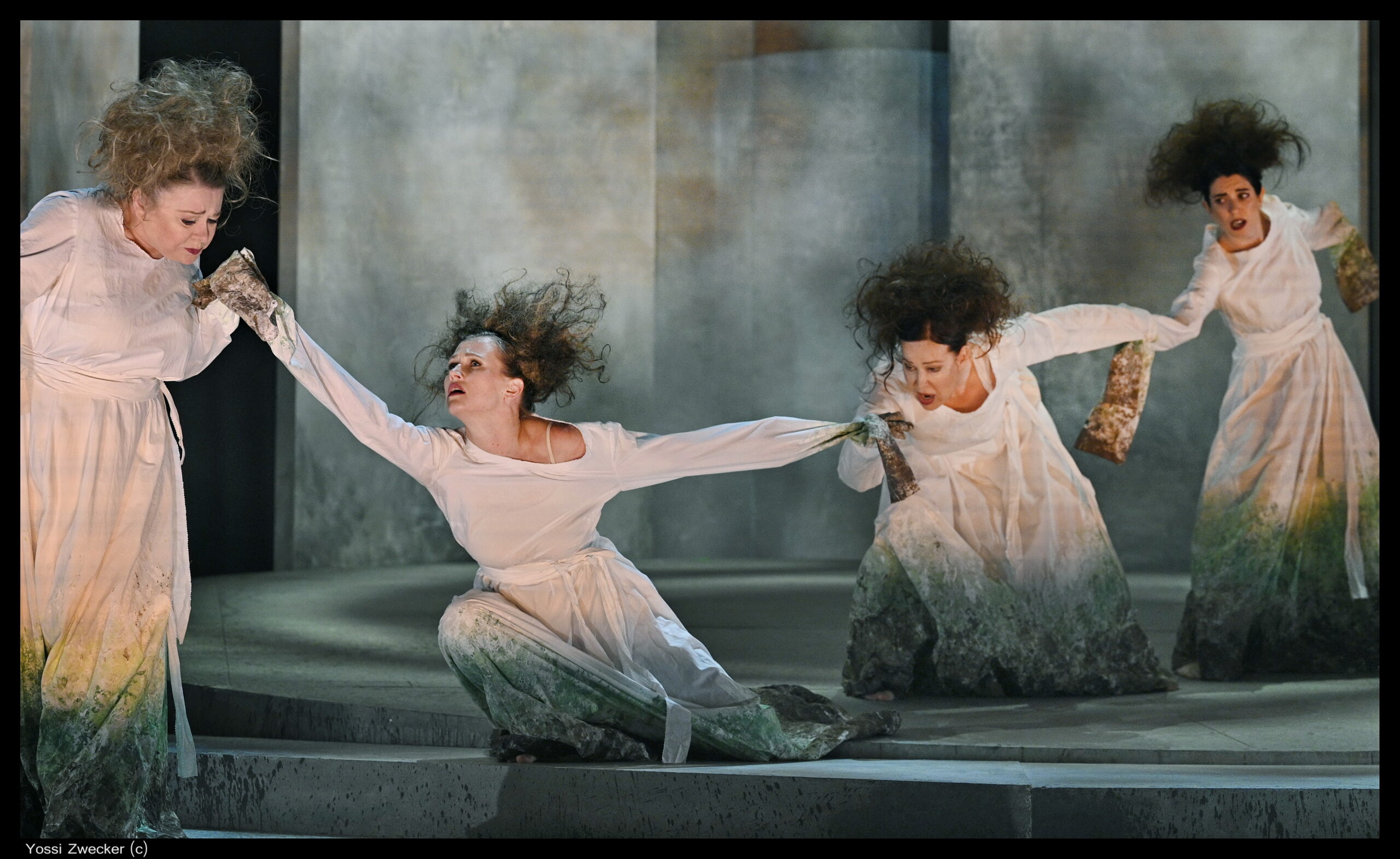
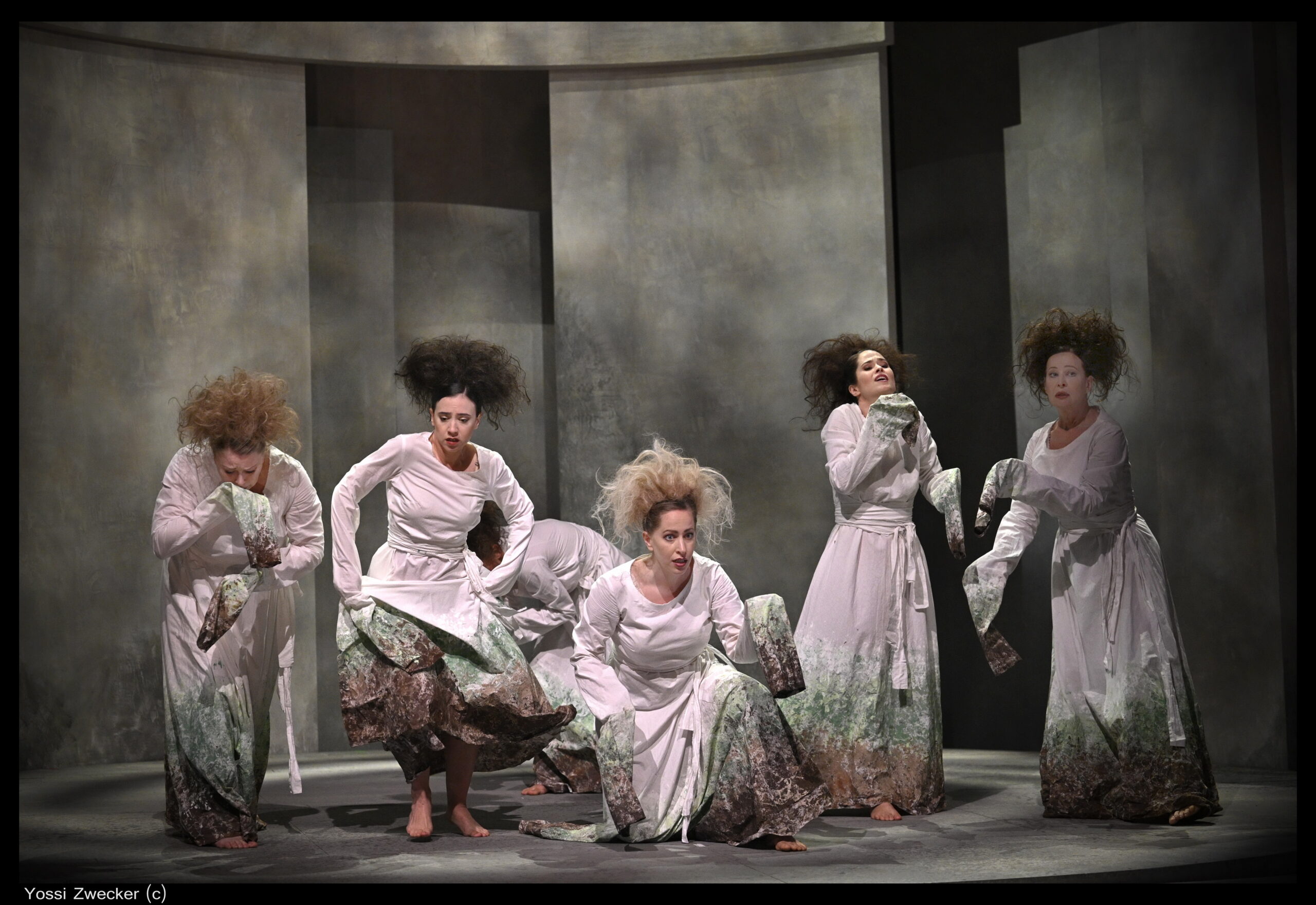
At the heart of the Book of Genesis, the female characters throb, but at times they seem to pass through it like ghosts – present yet transparent, decisive yet silenced. The opera Mothers by David Zeba gives them back their voices as they have never been heard – literally – and places their stories that they could never tell at the center. These are women who dared to want, to choose, to change their fate, sometimes at a heavy price.
Zeba wrote and composed a work for four opera singers on the variety of female voices: high soprano, soprano soprano, mezzo soprano and alto, and each singer sings several characters of mothers from the book of Genesis, except for the high soprano who sings the role of God. Alongside the operatic singing, four actresses from the Gesher Theater participate in the production, bringing to the stage an authentic theatrical layer of biblical female characters.
David Zeva – A musical language that begins from the heart
Composer David Zeba, one of the most important and active composers and creators in the field of classical music in Israel today, has an extensive repertoire that includes orchestral works and operas for children and adults. Zeba wrote both the libretto and the music for the opera Mothers . Zeba succeeds in creating a personal musical language that draws from local sounds – Hebrew, Mediterranean, traditional – and uses them to create a musical world full of sophistication and sensitivity. In the opera Mothers , he touches on impressionism, contemporary Israeli music, and a deeply emotional counterpoint that connects to his poignant and poetic text. His virtuoso mastery of the Hebrew language allows Zeba to connect the biblical language with modern Hebrew and to give the inner world of characters written 3,000 years ago a vibrant and exciting existence even in the 21st century.
When God speaks – and sings in a soprano voice
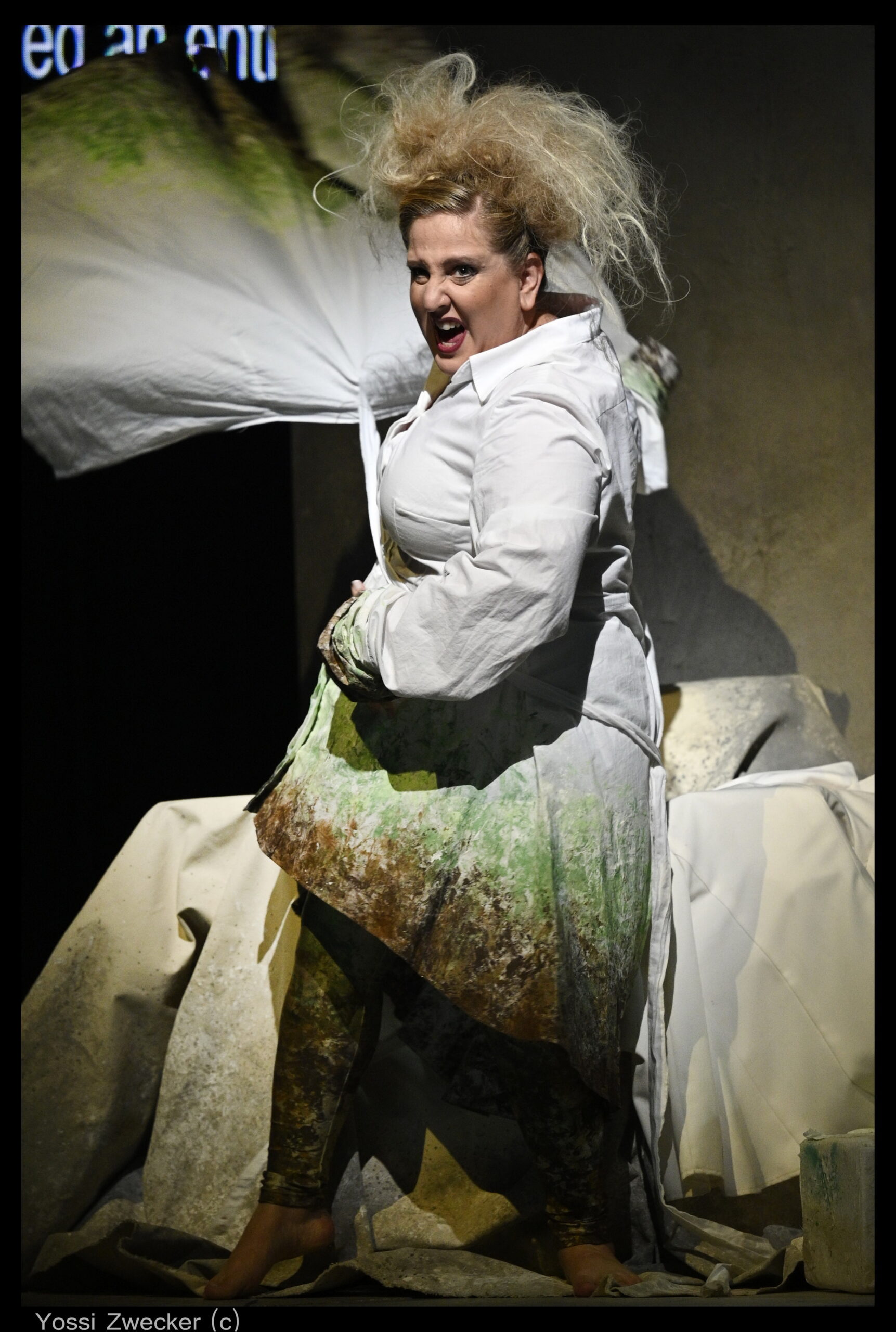
The choice to cast God as a soprano is not accidental. The role is written as an especially high and supreme voice capable of expressing, with its strength and range, assertiveness and power as well as lightness, delicacy and angelic softness. The image of God has two great, virtuosic, witty and grotesque arias that interpret the humanizing God and present him as vulnerable, offended, vengeful and with preferences in his love. Through these arias, God in the opera is not a narrator or author – but a participant, observer and critic.
A very important part of the character of God are the composed recitatives that are sung before each scene, all of which are based on precise quotes from the Book of Genesis. And between the singing and the recitatives – the audience hears not only the story of the mothers, but also the divine interpretation of the biblical stories presented in the opera.
Sin and its Punishment – The Struggle of Biblical Mothers
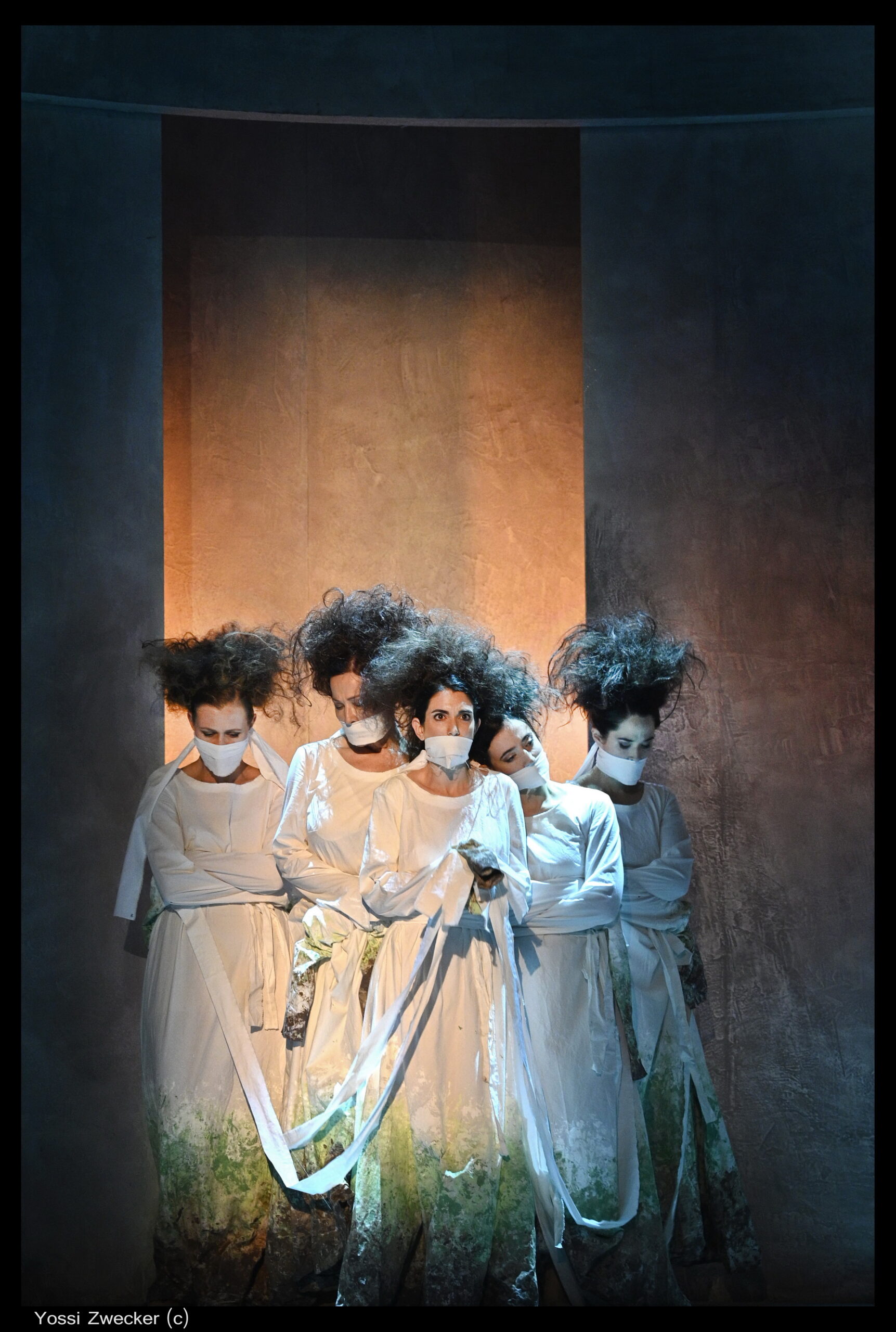
In a male-dominated biblical world, where the female voice is often only registered as an echo of the male voice, women seek ways to change their fate, to make their voice and will heard. In a society where women are considered property, a reward or a punishment, they are forced to use creative ways to achieve their goals.
They sin – to be heard. They sin – to survive. But in the end they pay a price for their sin.
Rachel and Leah – Leah with the soft eyes and Rachel with the beautiful face and face were both married to Jacob through a ruse by their father Laban. Thus, the two sisters find themselves in Jacob’s tent as they deal with the complex feelings between themselves, between themselves and Jacob, and between them and their father. Leah was a full accomplice in her father’s ruse – she knew that it was not her that Jacob wanted to marry, yet she pretended to be Rachel so that Jacob would come to her and dedicate her to him. She is granted the right to be the mother of six of Jacob’s sons: Reuben, Simeon, Levi, Judah, Issachar and Zebulun, and of his daughter Dinah. But the punishment she is sentenced to at the end of the act is to live the rest of her life with a husband who does not love her.
Unlike Malachai, Rachel was barren for many years until God opened her womb and she gave birth to Joseph and Benjamin (and died giving birth to Benjamin). Was Rachel complicit in her father’s deceit? And if so, were her barrenness and death in childbirth merely punishment for her sin.
Either way, despite the suffering that befell the two sisters, they both were blessed with giving birth to the offspring who would become the leaders of the Jewish people.
Rebekah – the mother of Esau and Jacob, loves her younger son only slightly more than his twin brother. Her love for Jacob leads her to deceive her husband Isaac into giving his blessing to her favorite son – Jacob. In a masculine household where the only voice that counts is the father’s, Rebekah has no way to express her opinion except through trickery. But her sin comes with a price tag – Jacob is forced to flee to Haran, and Rebekah – the one who pushed, guided, hoped for – is left alone. She never gets to see her son again.
Lot’s wife and her daughters –
Ostensibly, Lot’s wife is immediately punished for her sin of looking back, contrary to the divine command. But why did she look back? Zeba gives us an original answer to this question: While fleeing Sodom, she learned that her husband was willing to hand over her daughters to the men of the city so that they would rape them rather than his guests. Lot’s wife, whom the biblical author did not even give her a name of her own, pays the price for her husband’s sin and becomes a saltmonger.
Sin meets punishment – a closed circle
One of the most important and emphasized stories in Mothers is the story of Sarah and Hagar. Within the musical-theological construction of Mothers , a deep emotional circle unfolds that begins with a charged and heartbreaking duet between Sarah and Hagar, and culminates in Sarah’s great aria during the binding of Isaac and the emotional death of the mother’s heart. It all begins with a decision: Sarah, the mother who was initially barren, chooses with no choice but to give her maidservant Hagar to Abraham in order to have an offspring. It is a difficult decision, one that is both generous and controlling. But when Sarah finally gives birth to a son for Abraham, she is no longer willing to tolerate the presence of Hagar and her son Ishmael. She demands that they both be expelled, telling Abraham:
“ Cast out this mother and her son . “
In the work, the words “ Take your son,” which Sarah says to the character of Hagar, open their joint duet and are sung by the character of Sarah in a climbing melodic line, slow but decisive, like a kind of command that breaks out of a storm of suppressed emotions. This line, which rises from a distance of repressed and building pain, will become a resounding musical motif, which will return in a completely different moment of reversal of fate. Years later, Sarah hears the same words almost spoken to her, when God commands Abraham: “ Take your son… and offer him up as a burnt offering . “ These words make Sarah a victim of the same sin that she herself committed with Hagar.
In Sarah’s great aria, towards the end of the opera, she sings the words: “ Take my son “ in the same melodic line in which she once said to the emigrant, “ Take your son, “ but this time the melody moves from top to bottom , as a musical metaphor for the fall. This is a moment of catharsis, in which the same melody takes on an opposite meaning: from repulsion to embrace. From expulsion to supplication. From the controlling mother to the broken mother. Zeba’s music here is not just a dramatic device, it offers us a new reading of the biblical story. The melodic lines, almost identical but in opposite directions, create the sense of a circle that has closed . It is a circle of sin, of judgment, of role reversal – and above all of a tragedy created by a too-late insight into the pain of expulsion into the unknown.
And Sarah’s punishment ? Not expulsion, not the voice of God, but a quiet death, the death of the heart . The Sages say that Sarah died when she heard of the binding of Isaac. Not of his death, but of the very knowledge that her husband was willing to sacrifice her son for God, just as he sacrificed Ishmael for her. She is one of the only characters in the Bible who died for an emotional-mental reason, not a physical one. In this way, the opera gives Sarah the full depth of the tragedy – not only as “the mother of Isaac” but as someone who finally experienced in her own flesh the same suffering that she had sentenced Hagar to .
3,000 years later, the voices of women in the Book of Genesis tell us, in the words and melody of David Zeba, what has not yet been heard, projecting the place of women in our history and in our lives today, and wondering about the essence of motherhood. Since it was written 9 years ago, Motherhood has become a milestone in the original Hebrew operatic work, and has made David Zeba one of the most important and respected composers working in our time.