The story of opera in Israel and its history could have become the plot of one of the most fascinating operas of all time. It is the story of pioneers who fought tirelessly to realize their artistic vision in a country that had not yet been founded. It is a story of struggle and love, of faith and despair, a story that ultimately, 93 years later, places Israel proudly on the international opera map.
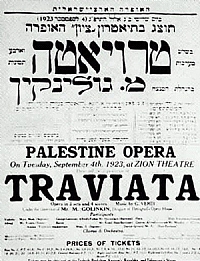
This is a story that began in 1917 in Moscow, where Mordechai Golinkin wrote down his plan to establish a Hebrew opera theater in Israel. Six years later, Golinkin arrived in Palestine to fulfill his dream. Opera in Israel before the establishment of the state was born on July 28, 1923, with the performance of Verdi’s La Traviata in Tel Aviv. At that time, there was no opera house in the city, which was completely covered in sand, and the opera that Golinkin founded in Palestine was forced to perform in movie theaters that were not intended for this purpose. But the opera took its first steps towards establishing itself. Golinkin directed the Palestine Opera for four years.
After him, composer Marc Lavrie and conductor Georg Singer founded the opera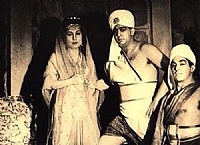 The popular Eretz Yisrael opera, which operated between 1940 and 1946, staged 16 productions, including the first Hebrew opera, Dan Hashomer, by Marc Lavry, the poet S. Shalom, and the writer Max Brod.
A fundamental turning point occurred on November 13, 1945, when the American soprano Addis DePhilip landed in Israel and soon established the Israeli National Opera. Thus, with its establishment, the new country had its own opera house. DePhilip’s opera house continued to perform operas every evening throughout the country. DePhilip even managed to attract young opera stars in their early years to spend some time in Israel and hone their skills in Tel Aviv. A young Spanish tenor spent three years in Israel in the early 1960s. Here in Tel Aviv he learned the best tenor roles before his name became known to the whole world. His name is Plácido Domingo.
In 1982, the Israeli National Opera was closed by decision of the Ministry of Education and Culture. But artistic life in Israel could not be complete without an opera. The Council for Culture and the Arts under the Ministry of Education undertook to create a new framework for operatic activity in Israel. In 1985, with the signing of the agreement that the Israeli Chamber Orchestra would be the opera’s permanent orchestra, Uri Ofer was appointed as the opera’s general director and Yoav Talmi was appointed as its musical director. At that time, the opera became an independent entity, with the main source of funding being the Tel Aviv-Jaffa Municipality.
The first production of the New Israeli Opera was Purcell’s Dido and Aeneas, which was staged at the Cameri Theater in Tel Aviv as a collaboration between the New Israeli Opera, the Israeli Chamber Orchestra, and the Cameri Theater. The organizational framework established for this production (and which continued to function thereafter) was headed by Uri Ofer, the then general director of the Cameri Theater and later the general director of the opera for the first decade of its existence, and Yoav Talmi, who was the musical director of the Israeli Chamber Orchestra and the New Israeli Opera. This new framework was encouraged by the mayor and the living spirit behind the enterprise, Shlomo Lahat, and the chairman of the Council for Culture and the Arts, Avner Shalev. In 1986, Gary Bertini was appointed artistic advisor to the opera, and upon the end of Yoav Talmi’s tenure as the opera’s musical director (in 1988), Bertini was appointed musical director of the new Israeli Opera. After that, Asher Fish and David Stern, Daniel Oren, and today the musical director of the Israeli Opera is Dan Ettinger.
The Israeli Opera, founded in 1985, is today one of the pillars of Israeli culture – a vibrant international opera house that emphasizes the dramatic and theatrical aspects of opera art and presents the world’s leading opera artists alongside many Israeli opera artists to its subscriber audience.
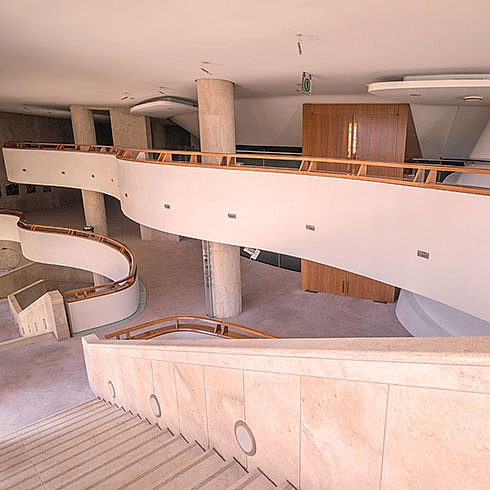
The Israeli Opera currently has an audience of approximately 18,000 subscribers and is growing steadily, putting on an average of eight productions each season. Today, there is regular collaboration between the Israeli Opera and leading opera houses around the world, and the Israeli Opera enjoys enthusiastic reviews in the world opera press for its performances in Israel and abroad. All Israeli opera productions are sung in the original language, accompanied by Hebrew and English subtitles, and are presented at the Opera House in the Tel Aviv Performing Arts Center, which opened in 1994. Since 2001, the Israeli Opera has also presented dance performances, classical music, jazz, and children’s music series at the Opera House.
In October 2005, the Israeli Opera unveiled the “Founders’ Corner”, a special wall in the opera house’s foyer dedicated to commemorating the pioneers of opera in Israel.
The Israeli Opera is supported by the Ministry of Culture, the Tel Aviv-Jaffa Municipality, as well as private individuals and commercial entities that donate to the opera.
Since 2010, the Israeli Opera has been hosting the Masada Summer Festival, where huge productions of the best operas are performed by hundreds of soloists from all over the world. In 2010, the opera Nabucco was performed, in 2011 Aida, in 2012 the opera Carmen was performed, in 2014 La Traviata, and in 2015, two huge productions of Puccini’s Tosca and Orff’s Carmina Burana were performed. With this, the Israeli Opera is proud to join the ranks of international opera festivals around the world that take place in the summer.